Showing posts with label running. Show all posts

Monday, February 21, 2011

Marathon B-Standard Part 2 of 2: Profiles in Courage

The second part of this blog topic is simple.  I already suggested that a Marathon Olympic Trials B standard for men inspires hundreds of athletes, who in turn inspire a new generation of runners.  This post is dedicated specifically to just a few examples of those American "B" type athletes, who at one point in their career or another were not expected to perform, but were somehow given another chance. 

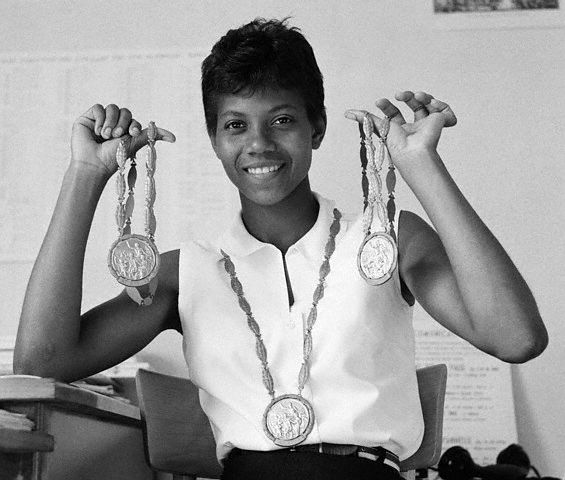
Wilma Rudolph -
     Talk about a woman who overcame obstacles:  if growing up poor and black in the 1940s wasn't enough, add a premature birth (at 4.5 pounds birthweight, to be exact) and the fact that she was the 20th of 22 children born to the same family.  Wilma Rudolph had to face a racist culture and literally rewrite many standards.  She is credited with many integration efforts, particularly in her home state of Tennessee, where she refused to take part in a segregated welcoming parade. 
     What inspires me most about Wilma Rudolph is the fact that she contracted polio at the age of four and was told that she may have difficulty walking for the rest of her life.  Her dedicated family not only traveled great distances to take her to the doctor, but they learned how to perform massage physical therapy and treated her left leg several times a day.  Eventually, she not only outgrew the leg braces that she wore, but she challenged every boy in her town to race. 
     The fact that she got the opportunity to race in the sport of track and field at all is a miracle, as her high school didn't have a track team.  Luckily, Ed Temple of Tennessee State University saw talent in a young basketball player and recruited her to run in college. 
    Polio wasn't the only affliction that Wilma Rudolph overcame.  By the time she was twelve, she had also contracted scarlet fever, whooping cough, chicken pox, and the measles.  Without opportunity to show her talent, the world would never have known who Wilma Rudolph was.  She is reason number 1 to give more athletes the opportunity to compete.

Katherine Switzer -
   Say what you will about Katherine Switzer and her running career.  Without her literal efforts to create opportunities for women to run, the women's marathon might not have become an Olympic event in time to know how great Joan Benoit (Samuelson's) victory could be. 
   Because she was willing to defy the standards of who could and couldn't run the Boston Marathon in 1967, she allowed others to follow in her footsteps.  It's hard to imagine the Boston Marathon today without the drama of women's racing.  Not to take anything away from the men, but I will not soon forget the nail-biting race in 2009 where the first three women's finishers were separated by eight seconds.  Katherine Switzer is living proof that a wider door of opportunity is good for the sport and its competitors. 

Brian Sell -
  Maybe you're thinking that Sell doesn't fit in this category.  There is nothing "B" rate about him.  He is a stand-up guy with a family, a job, and the resources of the Hansons-Brooks Distance Project behind him (or at least, this was the case until he retired from the sport).  But somehow his image became synonymous with "blue collar" running after his gutsy yet unsuccessful performance in the 2004 Olympic Trials.  He led the race until mile 21 that day, and finished a disappointing 13th.  By qualifying for the Olympics four years later, Sell proved that hard work pays off.  He may not have been ready to run fast enough to drop the field in 2004, but in 2008 he broke away and held on to earn his spot.  
    In many respects, Sell is the prime argument for a "B" Standard because he believed in himself enough to put in the necessary miles for nearly a decade after college in order to transform into a great marathoner.  He begs the question:  how many other great US Marathoners are waiting to blossom with years of consistent training?  I challenge the USATF to consider the drop in numbers of men who are training for 2012 versus previous Olympiads.  If we deplete the talent pool by discouraging some of our younger runners, the chances of competing successfully on an international level go down.
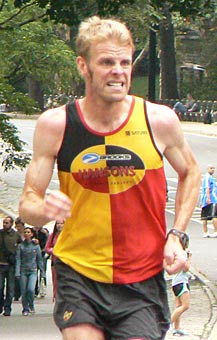

Dan Hocking -
   Okay so maybe I'm a bit biased on this one.  I just finished Elizabeth Gilbert's Committed and read that we tend to put tremendous pressure on our spouses here in America.  We don't just want life partners, we want spouses who inspire us.  Dan may be my husband and an inspiration to me, but I think he fits the description of any generic fill-in-the-blank US runner who dreams of competing on a national level and just needs reason to hope as motivation to train. 
    The reason why I single Dan out is that he deserves the opportunity to compete.  After an injury to a tendon in his hamstring that ended his college career early and prevented him from joining a professional running club, he was forced to take six years off from running.  Any occasional jog would be incredible painful physically, but it was more of a psychological blow than anything.  I can't imagine dreaming of all the national competitions he might qualify for one day, to then hoping merely for a chance to play tag with his nephew without pain the next day. 
    I should admit that the lack of an Olympic Trials "B" Standard doesn't hurt Dan all that much; he's talented enough that he has every right to dream of making the "A" Standard. 

I could go on.  There are hundreds of examples of athletes who have overcome obstacles because they were given opportunities, and because they believed in themselves enough to create an opportunity.  For today, my point stands that adding a "B" Standard for the men would be a benefit for today's athletes as well as the future of the sport. 

Sunday, January 30, 2011

Why the US Men Should have a "B" Standard for the Olympic Trials (Part I of II)

I'm a bit fired up at the moment, so I figured I would use the energy to get on my soap box about the US Men's Olympic Trials.

First off I should admit that my goal is to qualify for the Women's Marathon Olympic Trials "B" Standard, so I know something about shooting for a goal.  I've already tried twice and fallen short.

The key argument for a "B" Standard may go without saying, but I have to say it anyway.  It inspires a generation of runners.  Those men (and women) who work hard just to qualify for the "B" Standard may never make an Olympic Team, and that may not even be their goal.  But why put them on the line?  People like me (that is, people with limited ability) need a reason to reach for greatness.  We need the inspiration that is allowed when someone like Brian Sell qualifies for the Olympic Team, because without an attainable goal to begin with, how many people of Sell's caliber would get out there every day and train?  I am not trying to knock Brian Sell here; clearly he is a talented runner.  But his biggest PRs came after years of diligent training without big payoffs.  Without a group like Hansens willing to invest in a runner like him, how on earth would he ever have made it as far as he did?

For people slightly less talented than Brian Sell, there may not be clubs waiting in line to sign them for a running contract.  They need to work full time to put food on the table.  They don't have time for naps or massages.  They may need even MORE years to grow and develop as runners than those who are already close to the "A" Standard.  But who is going to bust their butt for years without any foreseeable payoff?  The time goal is just an arbitrary number, so even if the USATF set the "B" Standard at just one minute slower than the "A" (2:19:00), it would give hope to an entirely new pack of runners who are now in shooting distance. 

This brings me to a result of that inspiration:  faster runners out front.  If more people qualify for and enter the Olympic Trials, it puts a bit more pressure on those men vying for the top three spots.  If just one of those "B"-rate guys performs on the right day, it forces every other racer ahead of him to speed up (and every racer behind him to chase).  Let's just say, having more people toe the line means it keeps everyone honest.  Then racers have to beat a hypothetical 200 men in order to earn an Olympic Berth, rather than 100 or so.

A third reason is that it actually increases the prestige of the race.  This may be counter-intuitive, since it would seem that having a more stringent guideline as to who qualifies for the Olympic Trials makes it a more elite field, but if you think about the marathon, it doesn't quite work that way.  If you've read my previous blog posts, or if you've ever run a marathon yourself (or even a shorter race), you know that some days may be "on" days, and others . . . well, they're just "off."

Even some of the best marathoners in the world have "off" days.  Look at Deena Kastor in 2010.  She had a rough day in London, but she still finished in a disappointing 2:36 (over 16 minutes slower than her PR).  In the past, our top American (yes, that's Kastor again), has been reduced to walking in marathons, or slowing dramatically.  If that "off" day happens a few times, it can effectively ruin the chances of a sub-elite runner to make it to the trials.  Also, as I can personally attest to, shooting for a fast time in the marathon can be disastrous in the later miles of the race when it all catches up to you.  Having no safety net could potentially make some very talented runners go out over their heads and die, whereas a more conservative approach might yield them a net time faster than they could achieve with such lofty and strict goals.  If a newcomer to the marathon has only a few chances to try for a qualifying time (because one can only run so many marathons in a year and run them well), then it's safe to say trying for an astronomical time is not the best strategy for them.  However, that same runner, given the chance to merely worry about "qualifying" for the trials, and then given the time to improve over the course of a year or two (because the qualifying window for the trials is two years long), may be that blue-collar guy who challenges the lead pack, or even the chase pack, to keep their pace honest on the day of the race. So to explain why a "B" Standard increases the prestige of the race, it means that the top three men get to say with more definitive clarity that they beat the best runners in the country on that day, and not have to qualify that with "well, the best of those who could afford to train full time," or "there may be others out there who will never know how fast they could've been if they had the opportunity" or "I only beat 100 guys."     

Reason number 4 (if you're counting) is why not?  I keep racking my brain for any benefits that the USATF, the Houston Marathon, or the 12-year-old boys sitting at home get from shutting out our second-tier runners from the sport, and I have yet to come up with a down side.  Let's say the race organizers have to plan for 200 people, they don't lose anything.  In fact, they come out ahead.  Of course the men who earn the "B" Standard don't get a paid trip to Houston, so the USATF loses nothing there.  The race organizers don't need to put out any more tables for elite water, because they can reserve that right for the men up front.  They may need a few extra voluteers to hand out water, and they may need to hire a few extra medical personnel (we all remember Ryan Shay).  But in comparison to the costs of putting on a race, the extra expenses would be minimal.

In fact, adding extra entrants into the field would increase revenue, because these runners are going to pay for everything associated with the race:  hotels, restaurants, memorabilia, photos, and not to mention the hotel and travel expenses for the spouses and loved ones who would travel with them.  So let's recap our economic evaluation:  the USATF gains revenue (entry fees? merchandising); the Houston Marathon gains revenue (entry, spaghetti dinner and other pre- and post-race offerings); the community gains revenue and tourism dollars (hotels, restaurants, and positive word of mouth where "I went to Houston and had a wonderful time!").  Plus, think about all of those 12-year-olds at home watching their local hero run in the Trials.  They are much more likely to personally know a great runner if there are 200 men who toe the line than if there are only 100. 

Reason number 5 is equality.  I may have an over-developed sense of social justice, but I find it insulting to men and women both, to see that women have a "B" Standard, but men don't get the same chance.  Does this suggest that men are capable of greater feats than women? Does it suggest that women deserve more opportunities than men?  Does it suggest that little girls need role models, but little boys don't?  I can't figure out what message the USATF is trying to send by limiting one half of the race and not the other.  I honestly believe it would be more fair if the women only had an "A" Standard as well.  (But believe me, I appreciate the opportunity that the "B" Standard offers, and I wouldn't take it away from women in a heartbeat).

If you look at the world records in the marathon for both men and women, the qualifying times are incongruous at best.  The men's world record is 2:03:59, and the "A" Trials qualification is 2:19.  That's fifteen minutes slower, or about 15% slower in absolute time.  The women's world record is 2:15, and the "A" Trials qualification is 2:39.  That's twenty-four minutes slower or about 20% slower in absolute time.  Essentially, men are held to a higher standard than women in this scenario, which means that they do not have the same opportunities that women do.  If we are going to promote Title IX, give women equal pay for equal sporting feats, and generally cry out in the name of gender inequality, then it's time to cry out for our inspiring, hard-working, 9-to-5 men who just want the chance to compete with an equal opportunity as women.  (On a side note, these same men deserve the right to compete at the college level, where Title IX has had the unintended effect of cutting their scholarships and Track programs all together.)

 It's clear I find the lack of a "B" Standard upsetting, and my intention is not to upset you readers (yes, all three of you).  Maybe it's just something I needed to get off my chest, or maybe I can hope I've convinced even a few of you to believe as I do.

Wednesday, January 19, 2011

Lessons I've Learned from the Marathon: Social, Political, and Cultural

I decided to devote this posting to a bit more lighthearted lessons I've learned about the marathon.  I've completed six now (marathons, that is, not lessons), so I feel like I've picked up a few experiential nuggets of wisdom.

Lesson 1:  When people cheer "Looking good!" it means that you look like you are running.  Your feet are leaping off the pavement and moving forward with each stride.  When people cheer "Great abs!" it means that you no longer look like a runner, but a sunbather who likes to work out in the gym a few times a week.  In my most recent marathon, I got a lot of compliments on my abs during the latter parts of the race . . . ugh.  But more seriously,

Lesson 2: It is impolite to tell your friends and family that you had a bad race.  In the marathon, people find it oxymoronic to hear "I was disappointed with my finish in the marathon," as if merely finishing were the goal, all they hear is SUCCESS!  I find that it's best to nod and smile when people congratulate me on a disappointing performance, because in many ways, it is still an accomplishment to finish, especially on a day when the wrath of 26.2 is unkind to me. 

Lesson 3: You will be under-dressed.  Granted, all six of the marathons I've done have been big city marathons, but each time I feel almost amateurish showing up in my matching, professional club gear compared to everyone else.  You have never seen so much dry-fit inventory in your life until you show up at the start of a marathon.  You'll see grandmothers wearing layered, matching Nike warm-ups; you'll see custom made running hats; and if it's inclement weather, you'll see arm bands, jackets, compression socks, and thermal underwear.  Of course, you'll also see people wearing trash bags to the starting line, but underneath those trash bags you can bet you'll find lined running shorts.

Lesson 4:  Volunteers appreciate it when you do not spray them with water as you run by and try to grasp a cup.  This becomes problematic when, invariably at about mile 10, my left hand loses coordination.  If the water is lined up only on the left side of the road, I either have to turn my body to grab with my right, or I try with my left and smash the cup to the ground like I was giving it a high five. 

Lesson 5:  It is okay to draft, but people like their personal space.  My favorite spot is to run behind two tall men who can break the wind for me.  In exchange, all they usually ask is a few bits of information.  As long as I'm not too winded to tell them that I'm from the Boston area, they let me tag along.  But if I get too close, it's a safe bet that their next mile will be faster than mine. 

Lesson 6:  Fast friends are made on marathon courses.  Stick with another runner for a few miles, and he or she will remember your name for years.  I still remember the guy who helped me through a few tough miles of my first marathon (Nashville in 2007).  His name was Rick.  This may be common knowledge, but it's one of the greatest parts of the running community.  Everyone generally cheers for one another.  In such a competitive sport, we all recognize that in the end it's about pushing your body further than you thought you could.  I can't think of anybody that I think "Gee, I hope that person runs slowly today."  (However, I may think, "I hope I run faster than that person today.")

Next up, I'll delve into the physiological and psychological lessons I've learned from the marathon.  Tune in soon for Part II.

Wednesday, January 12, 2011

My Brag Book

With Christmas so recent, I have all kinds of new running gear to brag about, and I figure who else would want to read about this except for other running nerds who follow blogs?

Firstly, I haven't yet finished it, but my husband bought me Unbroken by Laura Hillenbrand and it's amazing (She's the same author who wrote Seabiscuit).  While not entirely devoted to running, it's a book about an incredible man who represented the United States in the 1936 Olympics in Berlin.  Every time I turn the page I find I have to remind myself that it's nonfiction.  The title character actually survived on an inflatable raft for 47 days and then found himself in a Japanese POW camp.  

Secondly, I now own the Nike Element Thermal running shirt and I have to say it might be my favorite gear ever.  It's not meant for temperatures below freezing, but it's great for a cold New England day in the 40s where you don't want to wear a full jacket.  I even sit around the house with it on after my run, and I find it's the only shirt that I don't shiver in.


Since I'm new to the blogging world, I'll keep this first post short and sweet.  Tune in for more in the way of actual running news and tidbits in the future.